

A T-shirt that costs less than a coffee feels harmless. Multiply it by billions of garments, worn a handful of times, and you get one of the most resource-hungry consumer industries on Earth. Fast fashion is not really a style problem. It is a volume problem: more clothes, made faster, from cheaper (usually fossil-fuel) fibres, and thrown away sooner. Here is what the evidence says about the scale of the damage, and where things are heading.
Key takeaways
We make far more clothing than we wear: output roughly doubled from 2000 to 2015 and is still rising.
Most of what is made is thrown away, not recycled. Less than 1% becomes new clothing.
Synthetic fibres turn cheap clothes into long-lived plastic waste and microplastic pollution.
The burden of the waste often lands far from the people who bought the clothes.
Laws are finally starting to make brands pay for what they make and discard.
Stage 1: Birth, in a field or an oil well
A T-shirt starts as either a crop or a fossil fuel. About 60% of global fibre is now polyester, which is plastic made from oil. The rest is largely cotton, which is thirsty: a cotton T-shirt is often put at around 2,700 litres of water, and a pair of jeans at around 3,781 litres across growing, manufacture, transport and washing (UN and industry figures).
Volume matters more than any single shirt. Global fibre production rose from 125 million tonnes in 2023 to 132 million tonnes in 2024, and could reach 169 million tonnes by 2030 on current trends (Textile Exchange). Left unchecked, the sector would also need about 35% more land for fibres by 2030, roughly 115 million extra hectares (UNEP).
Stage 2: The factory
Dyeing, finishing and stitching happen mostly in Asia, where power often comes from coal and gas. China supplied about 30% of world apparel exports in 2024, followed by Bangladesh (about 7%) and Vietnam (about 6%). Dyeing and treating textiles is responsible for around 20% of global industrial water pollution, according to UN Environment.
The waste starts here too. Manufacturers are estimated to discard 10% to 15% of fabric as offcuts when cutting and sewing. Apparel emissions of about 1.0 billion tonnes of CO2e in 2019 are projected to reach about 1.6 billion tonnes by 2030 if nothing changes. Exact shares of global emissions are debated (estimates range from 2% to 8%), but the direction of travel is not.
Stage 3: The warehouse, where some clothes never get a chance
Overproduction means some garments are never sold. A Dutch study found around 6.5% of store inventory went unsold, and it recorded around 600,000 garments destroyed before ever being worn. In France alone, an estimated 10,000 to 20,000 tonnes of textiles are destroyed each year. Since 19 July 2026, large companies across the EU are barred from destroying certain unsold goods, including clothing and footwear.
Stage 4: The wardrobe, a short stay
Fast fashion works because clothes are replaced quickly. The number of times a garment is worn has fallen about 36% worldwide compared with 15 years earlier, according to the Ellen MacArthur Foundation, and by about 70% in China. The same research estimates consumers forgo around USD 460 billion a year by discarding clothes that could still be worn.
Life in the wardrobe is not harmless either. Synthetic clothes shed microfibres, most of them in the first few washes. Fast fashion garments see a high share of first washes because they are low quality and short-lived, so they release a lot early. Textiles are estimated to send 200,000 to 500,000 tonnes of microplastics into the oceans each year.
Stage 5: The bin
Then comes the end. The UN says a truckload of textiles is landfilled or burned every second. Estimates of how much clothing material ends up in landfill or incineration range from about 73% to 87%, depending on method. Less than 1% is recycled into new clothing, and only about 13% is recovered in any form, mostly as lower-value products.
In practice, that looks like this:
Each European generates about 12 kg of clothing and footwear waste a year.
In the US, about 17 million tons of textiles were generated in 2018 and about 11.3 million tons landfilled. Only about 15% of clothing was recycled or reused.
Where landfills are unlined, as in about 80% of Vietnam's landfills according to one study, chemicals and fibres can leak into soil and water. Roughly one in five of Vietnam's incinerators lacked proper exhaust treatment or failed to meet air standards in the same study.
Global textile waste is projected to rise by more than 40% by 2035 without a major overhaul.
Stage 6: The long voyage
Many unwanted clothes are collected and shipped abroad as second-hand goods. That can help reuse, but it can also overwhelm the places that receive them. Accra's Kantamanto market in Ghana receives roughly 15 million garments a week. About 40% of each bale is discarded, and around 100 tons of unsold garments leave the market as waste every day, much of it ending up in lagoons, wetlands and the sea. Chile's Atacama Desert is also widely reported as a dumping ground for discarded imported clothing.
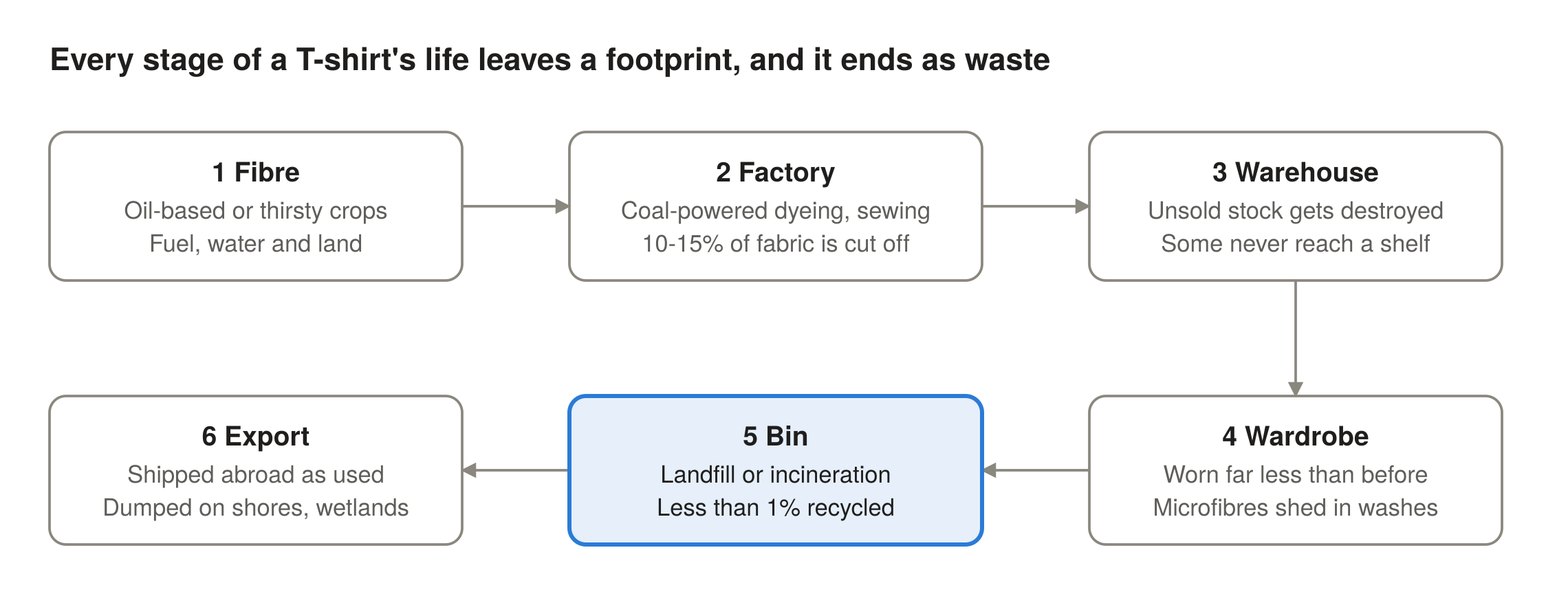
Whole Journey At a Glance
Why the cycle keeps spinning
Cheap synthetics make volume easy. When fibre comes from oil and is made at scale, it is cheaper to make more than to make things last.
Efficiency is not the same as reduction. Factories can get cleaner and still add emissions if total output keeps growing. One recent analysis reported by Bloomberg found fashion emissions up nearly 14% in two years.
The costs fall on someone else. Until now, the people who pay for fast fashion's waste have mostly been communities and ecosystems, not the brands.
What is coming next: 2026 to 2030
EU: Producer-pays rules for textiles were adopted in September 2025, and member states must have schemes running by 2028 (reported as April 2028 in legal commentary). Countries can charge higher fees to fast and ultra-fast fashion models. Customs duties on small parcels from outside the EU began on 1 July 2026.
France: Law 2026-602 (July 2026) defines ultra-fast fashion, adds heavier fees, and will ban advertising for such brands from 1 January 2027.
Pressure to coordinate: In June 2026, Germany, France, the Netherlands, Denmark and Slovenia asked the European Commission for EU-wide rules on ultra-fast fashion.
United States: California's textile programme is moving toward implementation, while bills in New York and Minnesota stalled in 2026.
The climate test: The industry has pledged a 45% emissions cut by 2030, but emissions are currently rising.
How to break the cycle
Make less, last longer. Brands can produce closer to demand and design clothes to survive many wears.
Wear what you have. Extending how long clothes are used is one of the most powerful levers, according to UNEP.
Repair, swap, resell, but do not let second-hand shopping become a reason to buy more. One study found second-hand shoppers often keep fast fashion habits.
Choose better fibres and care. Prefer durable natural or certified recycled fibres, and wash synthetics less often with a microfibre filter.
Back producer-pays laws. When brands pay for disposal, making things last becomes good business.
The bottom line
A fast fashion T-shirt does not disappear when it leaves your wardrobe. It keeps going: into a landfill, a furnace, a river or a shipping container. The planet's burden is the sum of how much we make and how quickly we throw it away, and for the first time the rules are starting to catch up with both.
Sources
Ellen MacArthur Foundation: A New Textiles Economy (abbreviated reading)
Fashion Dive: overproduction and destruction of unsold goods
UC Santa Barbara Bren School: Textile Trackers executive summary
Net Zero Compare: emissions rise nearly 14% in two years (citing Bloomberg)
Beveridge & Diamond: France's ultra-fast fashion law and EU EPR timeline
